
로고

비점오염저감시설 에코비젼21
로그인 회원가입
Non-Point pollution

Non-Point pollution

CONTACT US +82-41-582-1956 E.mail jbk4302@naver.com
  • Non-Point pollution
  • Introduction
  • Introduction

    Non-Point Source Pollution Control and Oil-Water Separation Systems
    A. Definition of the non-point pollution source

    Non-point pollution source refers to an emission source that discharges unspecified sewage pollutants from unspecified places such as urban area, roads, farmland, mountainous areas, and construction sites.

    B. Types of pollutants

    Soil, nutrients, bacteria and viruses, oil and grease, metals (lead, zinc, cadmium, copper, nickel, etc.), organic matter, herbicides, pesticides and fungicides and other impurities

    C. Explanation for the reduction principle of non-point pollutant

    01.The principle that non-point pollution reduction facilities reduce non-point pollutants, schematic diagram and flow chart of facilities


    02.Differentiated technical features from other non-point pollution reduction facilities

    Our system provides an excellent efficiency by using high density (HDPE) granulous filter media.

    Our filter is a high-density (HDPE) filter media to provide excellent SS adsorption efficiency. Most of facilities use “Geotex non-woven processed fiber” or “fiber ball”, which are excellent fiber materials for removing suspended solids (SS), but fibrous filter media has more disadvantages than advantages.
    Fibrous filter media is excellent for temporary removal of suspended solids, but long-term frequent floating debris makes backwashing difficult. There are many problems for maintenance with frequent replacing the filter media due to deformation of the filter media since the floating material residues cause blockage of the filter media by mold, insects, etc, in the underground manhole.
    High-density (HDPE) granular filter media, instead of fibrous media, has excellent backwashing and treatment efficiency by using highly efficient media. (SS treatment efficiency over 90% – see Attachment 1)

    Good backwashing effect

    Our high-density (HDPE) granulous filter media is shaped like a small cylinder with a specific gravity of 0.88, which is lighter than water. As the sludge is adsorbed to the granulous filter media, it becomes heavier than water and sinks to the lower part of the filter layer. It provides good backwashing effect because high-pressure air is intensively injected into the lower part where the contaminated filter media are gathered.

    Our facilities are economical

    Because high-density (HDPE) backwashable granulous filter media is used, the filter can be used semi-permanently only by backwashing. There is no filter abrasion, and the backwashing efficiency is excellent.
    No need to replace the filter media unless otherwise special deformation material enters the rainwater.

    D. Structure and characteristics of non-point pollution reduction facilities

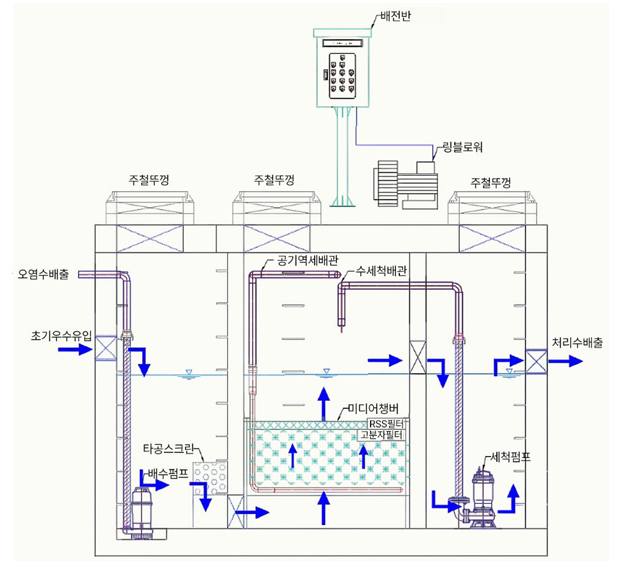
    The principle that the non-point pollution reduction facility reduce pollution including the overall structure of the facility and the characteristics of the detailed structure inside the facility

    Pre-treatment tank
    Sediment with a large specific gravity settles due to gravity, and the rising rainwater is transferred to the bottom of the filtration tank along the inlet pipe.
    Pre-treatment tank drainage pump
    Drains stagnant water in the pre-treatment tank after the end of rain
    Filtration tank
    The bottom and high-density (HDPE) granulous filter media are separated by a perforated net to remove contaminants of the influent.
    Drainage pump of filtration tank
    Drains contaminated backwash water
    High-density PE granulous filter media layer
    Filled with high-density PE granulous filter media
    (h=1000mm) by 70%
    Treated water tank
    Stores the treated water for backwash water feed
    Backwash water feed pump
    Transfers the backwash water to the filtration tank
    Backwashing facilities
    High pressure AIR inlet and AIR piping in the PE granulous filter media layer
    Ring blower
    located on the ground and generates
    and supplies high-pressure air
    Control panel
    Supplies electricity to each facility and controls operation
    Reverse wash water supply pump
    Transfer the backwash water to the filter tank

    E. Economy

    The filter provides a high-density (HDPE) granulous filter media with good efficiency and can be used semi-permanently (10 years)
    Has longer service life and superior backwashing compared to fiber filters
    There is no deformation unless otherwise heat is applied, and no need to change the filter media

    F. Convenience of maintenance

    ECOVISION21 (ECO-TYPE) filter material is designed for easy maintenance due to high-density (HDPE) and fluid formed in a round shape
    The filter is connected to the air line and can be backwashed, so it can be used semi-permanently after washing for about 5 minutes
    Settling tank and filtration tank are easy to dredge sediment through vacuum suction (the operator does not need to enter the tank)
    The facility is designed to transfer the stagnant water to a sewage pipe or wastewater storage tank through a pump.

    ■ Filter applied

    Item Unit Material propert
    Material 1.151
    Effective particle size mm 3.3
    Uniformity coefficien 3.3
    Specific gravity kg/㎥ 881
    Special coefficient m/sec 0.02
    Tensile strength kgf/㎠ 20 ~ 25
    Elongation % 400
    Melting mass flow index g/10min 0.7 ~ 1.0
    Service life Semi-permanent, no need to replace
    Crishing resistance N/㎠ 1.7
    Voids % 34.3
    Replacement cycle
    The filter can be used semi-permanently because it can be washed and reused unless otherwise there is deformation by external pressure such as chemicals or heat.
    Characteristics
    The filter made of HDPE material processed in a pellet shape is filled in the media chambe
    When the influent passes through the media chamber, it moves fluidly according to the level of the influent by the principles of gravity and buoyancy and reduces non-point pollution sources by precipitating and adsorbing fine solids and adsorbing oil components.
    The filter is hardly deformed, so it is reused after washing.
    In order to guarantee the activity of the granulous filter media during backwashing, the filling rate of the filter in the chamber is set to 70%.